

Organizational Effectiveness Teams
Organization Effectiveness (OE) teams ensure that an organization’s structure enables strategy, performance, and adaptability. Their work sits at the intersection of design, analytics, and change, helping leaders balance efficiency with flexibility while ensuring the right people and capabilities are aligned to strategic goals. Yet OE teams often operate with incomplete or inconsistent data, making it difficult to diagnose root causes or design lasting improvements.
Many redesign efforts begin with static org charts, headcount tables, and job summaries that fail to reflect how work is actually performed. This lack of visibility means OE practitioners must rely on interviews, surveys, or broad assumptions to define problems and propose solutions. Without quantitative insight into the flow of work, the composition of jobs, or the distribution of authority, even well-intentioned redesigns risk addressing symptoms rather than causes. Misaligned spans and layers, duplicated roles, unclear accountabilities, and unbalanced workloads often remain hidden beneath the surface of reported performance issues.
The challenge extends beyond design. Once new structures are implemented, few organizations have a consistent framework to measure whether they function as intended. Without comparative data on performance, cost, and governance, leaders cannot verify whether a redesign improved efficiency, simplified decision-making, or reduced duplication. Efforts to balance standardization and local flexibility frequently stall without evidence showing where consistency adds value and where variation is justified.
OE teams are also expected to support broader transformation initiatives and advise on workforce stability, leadership continuity, and organizational health. Yet traditional tools rarely provide a unified view of how structure, capability, and governance interact. Data on performance, cost, and decision authority are often unavailable or disconnected, making it nearly impossible to track how structural changes influence outcomes over time. In short, OE teams are asked to optimize systems they cannot fully see.
How Orgsure Helps Solve These Challenges
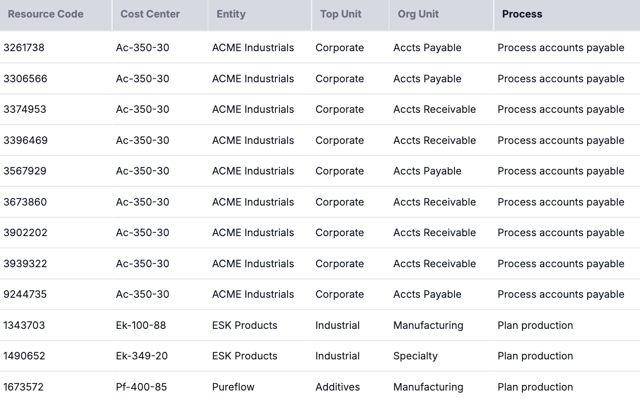
Orgsure equips OE teams with a complete, data-driven picture of how the organization operates, replacing assumption with evidence. Every position is mapped to its activities, time allocation, cost, value contribution, and performance results. These activity-level details roll up across units, functions, processes, capabilities, and value streams, creating a comprehensive view of how work is structured and how it supports strategy.
Structural measures such as span and depth of control, organization levels, centralization, and standardization help OE teams evaluate complexity and efficiency. Job similarity and uniqueness metrics reveal where positions with the same title perform different mixes of work, highlighting inconsistency or redundancy. This level of insight enables OE practitioners to propose redesigns grounded in measurable evidence rather than perception.
By connecting position-level data to higher-level structures, Orgsure also exposes the relationships between design and performance. Workload, strain, and intensity measures show where teams or roles are overextended, while governance measures (budget, decision, and execution authority) clarify who is accountable for results and where control gaps exist. These insights support more balanced decision-making structures and stronger role clarity.
Orgsure’s multi-lens view allows OE teams to analyze performance and design through multiple dimensions: function, capability, job group, process, value stream, and organizational level. Misalignments between strategy and structure become immediately visible, as do opportunities to consolidate duplicated work or better distribute key capabilities. The same framework that supports current-state analysis can be used to test future-state models, ensuring that proposed changes deliver measurable improvement.
Once a redesign is complete, Orgsure provides the same measures to monitor ongoing performance. OE teams can track whether structural simplification, role clarity, and workload balance are sustained over time, and can flag early indicators of strain or drift. This continuity transforms redesign from a one-time event into a managed, measurable process.
With Orgsure, Organization Effectiveness teams gain the visibility and precision needed to build structures that work in practice, not just on paper. They can align strategy, capability, and accountability across the enterprise, measure the impact of design decisions, and guide leaders toward systems that are both efficient and adaptable.
Organizational Effectiveness Teams
Organization Effectiveness (OE) teams ensure that an organization’s structure enables strategy, performance, and adaptability. Their work sits at the intersection of design, analytics, and change, helping leaders balance efficiency with flexibility while ensuring the right people and capabilities are aligned to strategic goals. Yet OE teams often operate with incomplete or inconsistent data, making it difficult to diagnose root causes or design lasting improvements.
Many redesign efforts begin with static org charts, headcount tables, and job summaries that fail to reflect how work is actually performed. This lack of visibility means OE practitioners must rely on interviews, surveys, or broad assumptions to define problems and propose solutions. Without quantitative insight into the flow of work, the composition of jobs, or the distribution of authority, even well-intentioned redesigns risk addressing symptoms rather than causes. Misaligned spans and layers, duplicated roles, unclear accountabilities, and unbalanced workloads often remain hidden beneath the surface of reported performance issues.
The challenge extends beyond design. Once new structures are implemented, few organizations have a consistent framework to measure whether they function as intended. Without comparative data on performance, cost, and governance, leaders cannot verify whether a redesign improved efficiency, simplified decision-making, or reduced duplication. Efforts to balance standardization and local flexibility frequently stall without evidence showing where consistency adds value and where variation is justified.
OE teams are also expected to support broader transformation initiatives and advise on workforce stability, leadership continuity, and organizational health. Yet traditional tools rarely provide a unified view of how structure, capability, and governance interact. Data on performance, cost, and decision authority are often unavailable or disconnected, making it nearly impossible to track how structural changes influence outcomes over time. In short, OE teams are asked to optimize systems they cannot fully see.
- Mini Heading
Common Problems
Lack of Reliable Data
Lack of reliable data to guide redesign efforts.
Misaligned Structures
Misaligned structures that do not support business strategy.
Failure to Address
Failure to address duplication of roles or functions.
Unclear Accountabilities
Unclear accountabilities and decision rights.
Difficulty Defining
Difficulty defining optimal structures.
Poor Integration
Poor integration across business units or functions.
Resistance to Structural Change
Resistance to structural change from leaders or teams.
Inability to Assess Performance
Inability to assess performance across structural elements.
Difficulty Balancing Standardization
Difficulty balancing standardization with flexibility.
Inadequate Measurement
Inadequate measurement of organizational health.
How Orgsure Helps Solve These Challenges
Orgsure equips OE teams with a complete, data-driven picture of how the organization operates, replacing assumption with evidence. Every position is mapped to its activities, time allocation, cost, value contribution, and performance results. These activity-level details roll up across units, functions, processes, capabilities, and value streams, creating a comprehensive view of how work is structured and how it supports strategy.
Structural measures such as span and depth of control, organization levels, centralization, and standardization help OE teams evaluate complexity and efficiency. Job similarity and uniqueness metrics reveal where positions with the same title perform different mixes of work, highlighting inconsistency or redundancy. This level of insight enables OE practitioners to propose redesigns grounded in measurable evidence rather than perception.
By connecting position-level data to higher-level structures, Orgsure also exposes the relationships between design and performance. Workload, strain, and intensity measures show where teams or roles are overextended, while governance measures (budget, decision, and execution authority) clarify who is accountable for results and where control gaps exist. These insights support more balanced decision-making structures and stronger role clarity.
Orgsure’s multi-lens view allows OE teams to analyze performance and design through multiple dimensions: function, capability, job group, process, value stream, and organizational level. Misalignments between strategy and structure become immediately visible, as do opportunities to consolidate duplicated work or better distribute key capabilities. The same framework that supports current-state analysis can be used to test future-state models, ensuring that proposed changes deliver measurable improvement.
Once a redesign is complete, Orgsure provides the same measures to monitor ongoing performance. OE teams can track whether structural simplification, role clarity, and workload balance are sustained over time, and can flag early indicators of strain or drift. This continuity transforms redesign from a one-time event into a managed, measurable process.
With Orgsure, Organization Effectiveness teams gain the visibility and precision needed to build structures that work in practice, not just on paper. They can align strategy, capability, and accountability across the enterprise, measure the impact of design decisions, and guide leaders toward systems that are both efficient and adaptable.