

Operations Leaders
Operations leaders are accountable for ensuring that day-to-day work is executed efficiently, consistently, and in alignment with business priorities. Their success depends on maintaining high throughput, stable quality, and balanced capacity across teams and functions. Yet most operations environments lack the structural visibility required to achieve these goals. Leaders may track volumes, productivity, and costs, but they often cannot see how work is distributed, where bottlenecks form, or which roles and processes contribute most to performance.
Traditional reporting systems summarize totals without showing the structure of work beneath them. A team may appear efficient overall while hiding pockets of overload or redundancy. Activities that create value may be diluted by duplicated effort or unclear handoffs between departments. Decision bottlenecks frequently arise when accountability is dispersed, while gaps in supervision or role clarity can lead to inconsistent execution. Without clear insight into the relationship between structure and performance, operational improvement efforts rely heavily on observation or anecdotal evidence.
Peaks and troughs in workload present additional challenges. When capacity is stretched in one area and underused in another, leaders must reassign tasks or shift resources quickly, but they often lack data that reveals who performs which activities or how much time each consumes. These inefficiencies compound over time, driving higher costs and lower service quality. Moreover, structural decisions intended to improve efficiency, such as layering adjustments, span changes, or team consolidations, can have unpredictable effects if not supported by measurable evidence.
Operations leaders are also expected to balance efficiency with resilience. They must ensure that the organization can absorb variation in demand, maintain compliance, and sustain employee engagement. However, the data required to track strain, workload, and stability across teams is rarely integrated in one place. This leaves leaders unable to anticipate emerging risks or measure the operational impact of organizational design choices.
How Orgsure Helps Solve These Challenges
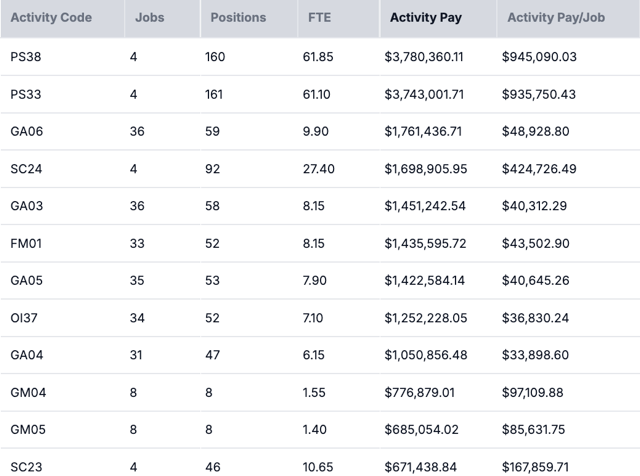
Orgsure provides operations leaders with a clear, measurable view of how work is performed and how structural choices affect performance. Every position is linked to its activities, each carrying time allocation, cost, and value data. This enables leaders to analyze the flow of work across units and identify precisely where resources are consumed, duplicated, or underutilized. Activity-level cost and value analysis highlights processes that generate strong returns versus those that drain capacity without proportional benefit.
Structural metrics such as span of control, depth of layers, centralization, and standardization reveal how reporting relationships and design choices influence speed, quality, and accountability. Job similarity and uniqueness measures expose redundant roles and overlapping functions, guiding consolidation where appropriate. Governance data clarifies who holds budget, decision, and execution authority, ensuring that responsibility for operational outcomes is aligned with control.
Performance tracking in Orgsure goes beyond output measures. Leaders can connect structural data to work composition, performance, and strategic measures, revealing how design affects results. Changes such as reorganizations or process realignments can be modeled before implementation to predict their impact and monitored afterward to confirm whether the expected benefits were realized. This evidence-based approach reduces the guesswork in operational improvement and allows continuous refinement of structures and processes.
With Orgsure, operations leaders gain the insight to manage performance proactively rather than reactively. They can identify inefficiencies, rebalance workload, and strengthen accountability using objective data. The platform transforms operational management from a cycle of observation and correction into a disciplined, data-driven practice. As a result, operations teams become more agile, consistent, and capable of sustaining both efficiency and service quality across changing business conditions.
Operations Leaders
Operations leaders are accountable for ensuring that day-to-day work is executed efficiently, consistently, and in alignment with business priorities. Their success depends on maintaining high throughput, stable quality, and balanced capacity across teams and functions. Yet most operations environments lack the structural visibility required to achieve these goals. Leaders may track volumes, productivity, and costs, but they often cannot see how work is distributed, where bottlenecks form, or which roles and processes contribute most to performance.
Traditional reporting systems summarize totals without showing the structure of work beneath them. A team may appear efficient overall while hiding pockets of overload or redundancy. Activities that create value may be diluted by duplicated effort or unclear handoffs between departments. Decision bottlenecks frequently arise when accountability is dispersed, while gaps in supervision or role clarity can lead to inconsistent execution. Without clear insight into the relationship between structure and performance, operational improvement efforts rely heavily on observation or anecdotal evidence.
Peaks and troughs in workload present additional challenges. When capacity is stretched in one area and underused in another, leaders must reassign tasks or shift resources quickly, but they often lack data that reveals who performs which activities or how much time each consumes. These inefficiencies compound over time, driving higher costs and lower service quality. Moreover, structural decisions intended to improve efficiency, such as layering adjustments, span changes, or team consolidations, can have unpredictable effects if not supported by measurable evidence.
Operations leaders are also expected to balance efficiency with resilience. They must ensure that the organization can absorb variation in demand, maintain compliance, and sustain employee engagement. However, the data required to track strain, workload, and stability across teams is rarely integrated in one place. This leaves leaders unable to anticipate emerging risks or measure the operational impact of organizational design choices.
- Mini Heading
Common Problems
Inefficient Processes
Inefficient processes that increase operating costs and waste capacity.
Poor Allocation of Resources
Poor allocation of resources across teams, leading to overuse in some areas and underuse in others.
Coordination Challenges
Coordination challenges between departments that disrupt process flow.
Bottlenecks in Workflows
Bottlenecks in workflows that slow delivery and reduce throughput.
Low Productivity
Low productivity caused by unclear roles, responsibilities, or decision authority.
Lack of Real-time Visibility
Lack of real-time visibility into operational performance and workload distribution.
Difficulty Balancing Workload
Difficulty balancing workload peaks and troughs across the organization.
Limited Insight
Limited insight into the operational cost and value contribution of activities and positions.
Quality Control Issues
Quality control issues that negatively affect customers and brand reputation.
Inability to Measure
Inability to measure the impact of structural decisions on operational efficiency.
How Orgsure Helps Solve These Challenges
Orgsure provides operations leaders with a clear, measurable view of how work is performed and how structural choices affect performance. Every position is linked to its activities, each carrying time allocation, cost, and value data. This enables leaders to analyze the flow of work across units and identify precisely where resources are consumed, duplicated, or underutilized. Activity-level cost and value analysis highlights processes that generate strong returns versus those that drain capacity without proportional benefit.
Structural metrics such as span of control, depth of layers, centralization, and standardization reveal how reporting relationships and design choices influence speed, quality, and accountability. Job similarity and uniqueness measures expose redundant roles and overlapping functions, guiding consolidation where appropriate. Governance data clarifies who holds budget, decision, and execution authority, ensuring that responsibility for operational outcomes is aligned with control.
Performance tracking in Orgsure goes beyond output measures. Leaders can connect structural data to work composition, performance, and strategic measures, revealing how design affects results. Changes such as reorganizations or process realignments can be modeled before implementation to predict their impact and monitored afterward to confirm whether the expected benefits were realized. This evidence-based approach reduces the guesswork in operational improvement and allows continuous refinement of structures and processes.
With Orgsure, operations leaders gain the insight to manage performance proactively rather than reactively. They can identify inefficiencies, rebalance workload, and strengthen accountability using objective data. The platform transforms operational management from a cycle of observation and correction into a disciplined, data-driven practice. As a result, operations teams become more agile, consistent, and capable of sustaining both efficiency and service quality across changing business conditions.