

Business Unit Leaders
Business unit (BU) leaders are responsible for delivering financial, operational, and strategic performance within their areas of accountability while remaining aligned with enterprise direction. They must balance autonomy with integration, driving local results while ensuring consistency, efficiency, and shared capability across the broader organization. Yet most BU leaders make these trade-offs with limited insight into how their unit’s structure, roles, and costs compare to peers or to enterprise standards.
Traditional reporting focuses on financial outcomes rather than the structural and work factors that drive them. BU leaders may see headcount and expense totals but lack the underlying data showing how work is distributed, where duplication exists, or which roles are most critical to value creation. This gap makes it difficult to determine whether resources are being used efficiently or whether the unit’s design supports long-term sustainability. Efforts to cut costs or streamline functions risk removing capability rather than waste, while growth initiatives may stretch limited capacity without visibility into workload balance or governance coverage.
In multi-unit organizations, duplication of work is common. Similar functions may operate in parallel, consuming resources while producing inconsistent results. Because accountability and authority structures differ across BUs, decision speed and quality vary widely. Leaders often inherit structures that reflect past growth rather than current strategy, and without a data foundation, they cannot easily identify where complexity can be reduced or integration increased.
Performance measurement poses another challenge. Units often track their own metrics, but comparisons across business units are hindered by inconsistent definitions and data sources. This fragmentation makes it hard for BU leaders to benchmark performance or share lessons learned. When budget allocations are tied to historical spending instead of the value or strategic contribution of work, investment decisions become reactive rather than strategic.
How Orgsure Helps Solve These Challenges
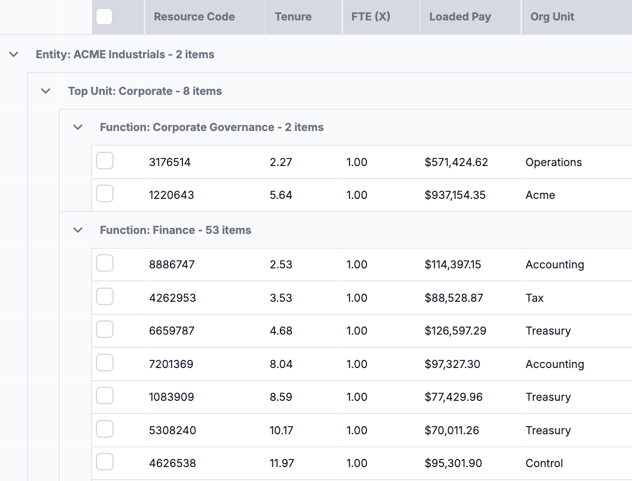
Orgsure provides BU leaders with a transparent, evidence-based view of how their organizations operate. Every position within the unit is mapped to its activities, each carrying detailed information on FTE allocation, cost, value, and performance. These data roll up through functions, processes, capabilities, and value streams, creating a multidimensional view of how work drives results. Leaders can see exactly where resources are consumed, what they produce, and how those patterns compare across units or against enterprise norms.
Activity-level cost and value analysis exposes high-cost, low-value work, duplicated effort, and redundant roles. Job similarity and standardization metrics show whether positions with the same title perform consistent work or have drifted apart in design or purpose. Structural measures such as span of control and depth of layers help identify inefficiencies in supervisory design, while centralization indicators reveal where decision authority is overly concentrated or too diffuse.
Governance tracking at the position level clarifies budget, decision, and execution authority, ensuring that accountability and control are aligned. This prevents both micromanagement and gaps in ownership, giving leaders confidence that decisions are made at the right level. By integrating financial and structural data, Orgsure allows BU leaders to connect cost directly to value and to ensure that spending aligns with strategic priorities.
Benchmarking within Orgsure enables meaningful comparisons between business units using standardized measures of cost, value, and structural efficiency. Leaders can see how their unit’s mix of strategic, judgment-based, and procedural work compares with peers, and can adjust their design accordingly. This comparability promotes consistency where it adds value while preserving flexibility where local context matters.
Orgsure also supports forward-looking management. BU leaders can model proposed changes, such as consolidating functions, rebalancing spans, or shifting work between teams, to understand the structural, operational, and financial implications before implementation. After changes take effect, the same measures track whether intended benefits were achieved and sustained.
With Orgsure, business unit leaders move from managing by aggregate results to managing by evidence. They gain the ability to see how structure, cost, and capability interact to produce performance, identify where complexity can be reduced without risk, and ensure that resources are aligned to the highest-value work. The result is a more agile, accountable, and strategically integrated business unit, one that contributes fully to enterprise success while maintaining local strength and adaptability.
Business Unit Leaders
Business unit (BU) leaders are responsible for delivering financial, operational, and strategic performance within their areas of accountability while remaining aligned with enterprise direction. They must balance autonomy with integration, driving local results while ensuring consistency, efficiency, and shared capability across the broader organization. Yet most BU leaders make these trade-offs with limited insight into how their unit’s structure, roles, and costs compare to peers or to enterprise standards.
Traditional reporting focuses on financial outcomes rather than the structural and work factors that drive them. BU leaders may see headcount and expense totals but lack the underlying data showing how work is distributed, where duplication exists, or which roles are most critical to value creation. This gap makes it difficult to determine whether resources are being used efficiently or whether the unit’s design supports long-term sustainability. Efforts to cut costs or streamline functions risk removing capability rather than waste, while growth initiatives may stretch limited capacity without visibility into workload balance or governance coverage.
In multi-unit organizations, duplication of work is common. Similar functions may operate in parallel, consuming resources while producing inconsistent results. Because accountability and authority structures differ across BUs, decision speed and quality vary widely. Leaders often inherit structures that reflect past growth rather than current strategy, and without a data foundation, they cannot easily identify where complexity can be reduced or integration increased.
Performance measurement poses another challenge. Units often track their own metrics, but comparisons across business units are hindered by inconsistent definitions and data sources. This fragmentation makes it hard for BU leaders to benchmark performance or share lessons learned. When budget allocations are tied to historical spending instead of the value or strategic contribution of work, investment decisions become reactive rather than strategic.
- Mini Heading
Common Problems
Conflicting Priorities
Conflicting priorities between corporate and BU objectives.
Duplication of Work
Duplication of work across BUs.
Limited Ability to Measure
Limited ability to measure the cost and value contribution of BU activities and roles.
Inability to Identify Critical Work
Inability to identify critical work gaps and capability needs when planning staffing changes.
Inconsistent Performance
Inconsistent performance metrics across units.
Inability to Link Budget Allocations
Inability to link budget allocations to the highest-value activities, roles, and capabilities.
Coordination Challenges
Coordination challenges with other BUs.
Unclear Authority
Unclear authority and control levels across the structure.
Lack of Accountability
Lack of clear accountability for results.
Inability to Evaluate
Inability to evaluate the operational and structural impact of BU-level changes.
How Orgsure Helps Solve These Challenges
Orgsure provides BU leaders with a transparent, evidence-based view of how their organizations operate. Every position within the unit is mapped to its activities, each carrying detailed information on FTE allocation, cost, value, and performance. These data roll up through functions, processes, capabilities, and value streams, creating a multidimensional view of how work drives results. Leaders can see exactly where resources are consumed, what they produce, and how those patterns compare across units or against enterprise norms.
Activity-level cost and value analysis exposes high-cost, low-value work, duplicated effort, and redundant roles. Job similarity and standardization metrics show whether positions with the same title perform consistent work or have drifted apart in design or purpose. Structural measures such as span of control and depth of layers help identify inefficiencies in supervisory design, while centralization indicators reveal where decision authority is overly concentrated or too diffuse.
Governance tracking at the position level clarifies budget, decision, and execution authority, ensuring that accountability and control are aligned. This prevents both micromanagement and gaps in ownership, giving leaders confidence that decisions are made at the right level. By integrating financial and structural data, Orgsure allows BU leaders to connect cost directly to value and to ensure that spending aligns with strategic priorities.
Benchmarking within Orgsure enables meaningful comparisons between business units using standardized measures of cost, value, and structural efficiency. Leaders can see how their unit’s mix of strategic, judgment-based, and procedural work compares with peers, and can adjust their design accordingly. This comparability promotes consistency where it adds value while preserving flexibility where local context matters.
Orgsure also supports forward-looking management. BU leaders can model proposed changes, such as consolidating functions, rebalancing spans, or shifting work between teams, to understand the structural, operational, and financial implications before implementation. After changes take effect, the same measures track whether intended benefits were achieved and sustained.
With Orgsure, business unit leaders move from managing by aggregate results to managing by evidence. They gain the ability to see how structure, cost, and capability interact to produce performance, identify where complexity can be reduced without risk, and ensure that resources are aligned to the highest-value work. The result is a more agile, accountable, and strategically integrated business unit, one that contributes fully to enterprise success while maintaining local strength and adaptability.