Organizations often treat pay as a cost to be controlled. HR and financial systems can easily report total compensation, average pay by function, or cost per FTE. Yet these summaries miss an important point inherent in all pay systems. Specifically, the distribution of pay, or how each position sits within its job-level pay range, has a direct effect on value.
Orgsure treats relative pay not simply as a descriptive statistic, but as a value driver. The system uses a position’s location within its pay range to adjust its calculated value, recognizing that the same work carries different return characteristics depending on whether it is over- or under-compensated.
Why Relative Pay Matters
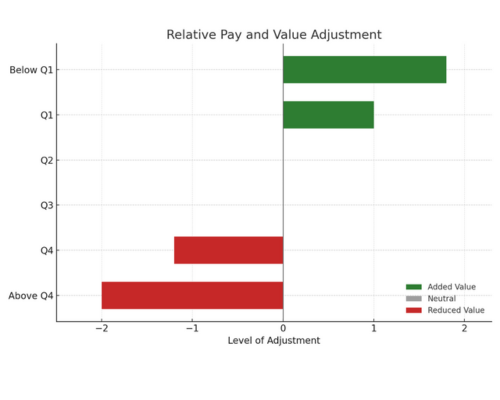
Pay levels communicate how an organization values work. Two people performing identical activities may deliver different value outcomes depending on what each costs to employ. A position paid in the lower quartiles of its job-level range produces higher relative value because the organization is achieving equivalent work execution for less cost. In Orgsure’s framework, this increases calculated value. Conversely, a position paid in the upper quartiles, or above the established range, reduces value because the organization is paying a premium for output that could likely be achieved at a lower cost. Unless the higher pay reflects proven scarcity or exceptional capability, the excess cost acts as a value decrement.
In short, relative pay is a modifier of value. Pay below range enhances it; pay above range erodes it. This adjustment converts compensation data from a static measure of cost into a meaningful indicator of organizational efficiency.
The Limits of Aggregate Pay Data
Aggregate metrics (e.g., averages, totals, or headcount ratios) mask the relationship between relative pay and value. A function may report an average salary within budget, yet still lose value if much of its payroll sits in the upper quartile. Another function with a lower average may over perform because its compensation is concentrated in the first or second quartile while still meeting performance expectations. These patterns remain invisible in traditional reporting. Without evaluating relative pay, leaders cannot tell whether cost efficiency reflects good design or hidden underinvestment. Orgsure resolves this by treating each position’s pay range location as a variable that directly shapes value, not merely as a descriptive characteristic.
How Orgsure Integrates Pay Distribution into Value Calculations
Orgsure connects compensation to value through its job-level framework. Every position carries a defined pay range. The system identifies where each position’s actual pay falls within that range (including those that are above or below the range limits) and adjusts value accordingly. This makes the link between pay and value explicit, measurable, and comparable across the enterprise. The result is a more realistic understanding of how compensation affects overall position value. Similarly, Orgsure can calculate the relative value of the organization’s many activities, providing higher-level insights into work across the enterprise. Orgsure’s approach helps leaders see not only how much is being spent, but how well that spending translates into value creation.
The Core Insight
Pay distribution is not just a fairness issue, it is a value signal. Orgsure incorporates each position’s pay range location into its value calculations to show whether compensation strengthens or weakens return. By embedding this logic into its analytics, Orgsure transforms pay analysis from an accounting exercise into a performance measure. It reveals how money flows through the organization, how efficiently it is deployed, and where value can be gained or recovered through better alignment of pay and work.
Suscipit nibh nunc eu mauris platea
Un horaire flexible signifie bien plus qu’un simple aménagement : il incarne une nouvelle manière de concevoir le temps de travail. Ces dernières années ont vu l’adoption croissante de concepts novateurs tels que les horaires flexibles, aussi appelés flexitime.