

Change Management Teams
Change management teams are responsible for ensuring that organizational transitions, whether structural, operational, or cultural, deliver intended benefits while minimizing disruption. Their work sits at the intersection of strategy, operations, and human behavior. Effective change management requires visibility into how work and roles will be affected, where risks to stability or engagement exist, and what actions are needed to prepare the organization for transition. Yet most change practitioners lack access to the data required to plan and manage these factors with precision.
Traditional change planning methods rely on stakeholder input, surveys, and qualitative assessments. While these provide valuable context, they often fail to reveal the detailed structural and workload implications of change. Leaders may know which functions are affected but not how deeply the changes reach into specific roles or how work redistribution will impact those who remain. This lack of granularity makes it difficult to anticipate points of resistance or stress, and to align communication and training efforts with real operational impact.
Most organizations also struggle to quantify readiness and risk at the individual or team level. Without consistent measures, change plans tend to treat affected groups uniformly, overlooking differences in strain, capability, or engagement. Critical dependencies between roles, where one change triggers another, are rarely visible. As a result, teams often discover unintended consequences only after implementation, when remediation becomes more expensive and less effective.
Finally, measuring the success of change initiatives remains a persistent gap. Without a clear baseline and comparable post-change data, leaders cannot confidently verify whether objectives were achieved or whether new structures perform as intended. Change fatigue, turnover, or productivity loss may signal deeper issues, but the root causes remain unclear when the underlying work and structure are not measured consistently.
How Orgsure Helps Solve These Challenges
Orgsure advances change management from a presentation-driven discipline into a measurable, evidence-based process. The system allows change practitioners to assign change impacts directly to each resource within the affected population, linking impact assessments to the organization’s actual data model. Because every position is connected to its activities, FTE allocation, cost, value, and governance attributes, change teams can evaluate exactly how work and responsibility will shift under each proposed scenario.
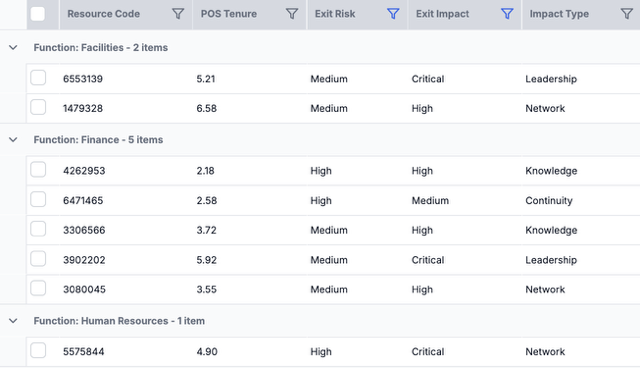
Orgsure incorporates several unique fields that enable practitioners to assess change impact and readiness with precision. These include strain, intensity, exit risk, readiness, engagement, work mode, and likely change role (champion or risk). Together, these indicators provide a comprehensive view of how each person or role is positioned to handle change. High-strain or low-readiness roles can be flagged for targeted support, while champions can be engaged early to reinforce adoption and communication.
Because all change data is integrated with Orgsure’s core structural and activity model, practitioners can see how proposed changes will affect cost, value, governance, and capability coverage before implementation. Dependencies between roles and processes are clearly mapped, allowing teams to identify where one change may inadvertently disrupt another. This clarity prevents resource overload, role conflict, or unintended gaps in control and accountability.
Once a change is implemented, Orgsure provides continuity between planning and evaluation. The same measures used to define the baseline, for example FTE, cost, value, strain, engagement, and authority, are tracked post-change to confirm whether expected benefits are realized and sustained. Practitioners can monitor early indicators of adoption and stability, enabling timely adjustments that keep transformations on track.
Orgsure’s activity-based data model also supports integrated reporting across transformation, HR, and operations teams. Change management becomes a shared, measurable discipline rather than a parallel process. Data-driven insights make it possible to connect human impact to structural and financial outcomes, ensuring that change success is defined not only by implementation but by long-term adoption and performance.
With Orgsure, change management becomes proactive, targeted, and verifiable. Practitioners can anticipate where disruption will occur, deploy interventions where they matter most, and demonstrate the impact of change in clear, quantifiable terms. The result is faster adoption, reduced resistance, and a more resilient organization, one equipped to evolve continuously and confidently.
Change Management Teams
Change management teams are responsible for ensuring that organizational transitions, whether structural, operational, or cultural, deliver intended benefits while minimizing disruption. Their work sits at the intersection of strategy, operations, and human behavior. Effective change management requires visibility into how work and roles will be affected, where risks to stability or engagement exist, and what actions are needed to prepare the organization for transition. Yet most change practitioners lack access to the data required to plan and manage these factors with precision.
Traditional change planning methods rely on stakeholder input, surveys, and qualitative assessments. While these provide valuable context, they often fail to reveal the detailed structural and workload implications of change. Leaders may know which functions are affected but not how deeply the changes reach into specific roles or how work redistribution will impact those who remain. This lack of granularity makes it difficult to anticipate points of resistance or stress, and to align communication and training efforts with real operational impact.
Most organizations also struggle to quantify readiness and risk at the individual or team level. Without consistent measures, change plans tend to treat affected groups uniformly, overlooking differences in strain, capability, or engagement. Critical dependencies between roles, where one change triggers another, are rarely visible. As a result, teams often discover unintended consequences only after implementation, when remediation becomes more expensive and less effective.
Finally, measuring the success of change initiatives remains a persistent gap. Without a clear baseline and comparable post-change data, leaders cannot confidently verify whether objectives were achieved or whether new structures perform as intended. Change fatigue, turnover, or productivity loss may signal deeper issues, but the root causes remain unclear when the underlying work and structure are not measured consistently.
- Mini Heading
Common Problems
Lack of a Clear, Measurable Baseline
Lack of a clear, measurable baseline before change initiatives begin.
Difficulty Predicting
Difficulty predicting the structural and operational impact of proposed changes.
Inability to Identify
Inability to identify roles and activities most affected by change.
Limited Insight
Limited insight into capacity and workload for roles involved in transition efforts.
Inability to Measure
Inability to measure whether intended benefits are achieved and sustained post-change.
Difficulty in Assessing
Difficulty assessing workforce stability and continuity risks during transition.
Gaps in Governance and Accountability
Gaps in governance and accountability during periods of change.
No consistent Method
No consistent method for comparing before-and-after performance at the role or activity level.
Lack of Data to Support
Lack of data to support targeted communication and stakeholder engagement.
Poor Integration
Poor integration of change metrics into broader transformation and operational reporting.
How Orgsure Helps Solve These Challenges
Orgsure advances change management from a presentation-driven discipline into a measurable, evidence-based process. The system allows change practitioners to assign change impacts directly to each resource within the affected population, linking impact assessments to the organization’s actual data model. Because every position is connected to its activities, FTE allocation, cost, value, and governance attributes, change teams can evaluate exactly how work and responsibility will shift under each proposed scenario.
Orgsure incorporates several unique fields that enable practitioners to assess change impact and readiness with precision. These include strain, intensity, exit risk, readiness, engagement, work mode, and likely change role (champion or risk). Together, these indicators provide a comprehensive view of how each person or role is positioned to handle change. High-strain or low-readiness roles can be flagged for targeted support, while champions can be engaged early to reinforce adoption and communication.
Because all change data is integrated with Orgsure’s core structural and activity model, practitioners can see how proposed changes will affect cost, value, governance, and capability coverage before implementation. Dependencies between roles and processes are clearly mapped, allowing teams to identify where one change may inadvertently disrupt another. This clarity prevents resource overload, role conflict, or unintended gaps in control and accountability.
Once a change is implemented, Orgsure provides continuity between planning and evaluation. The same measures used to define the baseline, for example FTE, cost, value, strain, engagement, and authority, are tracked post-change to confirm whether expected benefits are realized and sustained. Practitioners can monitor early indicators of adoption and stability, enabling timely adjustments that keep transformations on track.
Orgsure’s activity-based data model also supports integrated reporting across transformation, HR, and operations teams. Change management becomes a shared, measurable discipline rather than a parallel process. Data-driven insights make it possible to connect human impact to structural and financial outcomes, ensuring that change success is defined not only by implementation but by long-term adoption and performance.
With Orgsure, change management becomes proactive, targeted, and verifiable. Practitioners can anticipate where disruption will occur, deploy interventions where they matter most, and demonstrate the impact of change in clear, quantifiable terms. The result is faster adoption, reduced resistance, and a more resilient organization, one equipped to evolve continuously and confidently.