Organizations have long recognized that not all work is equal. Some activities demand deep expertise and professional judgment. Others rely on sustained effort, repetition, or rapid pace. Yet most organizational data systems treat all work as if it were interchangeable. Job descriptions, pay grades, and benchmarks describe structure and cost, but they miss the texture of work, what the work actually demands from people. Without this detail, leaders make structural and staffing decisions based on incomplete foundations.
The Limits of Conventional Job Data
Traditional HR and organizational data focus on position titles, broad responsibilities, and reporting lines. These elements are useful for administration, but insufficient for understanding the true nature of work. Two positions may have identical spans of control, pay grades, and even job titles. Yet one may depend on rare technical judgment and years of experience, while the other may consist of repetitive, procedural tasks that require endurance but not specialized expertise. Treating them as equivalent distorts analysis. It hides where capability risk exists, where work is over-designed or under-designed, and where resources may be mismatched to business needs.
Why Expertise and Intensity Must Be Measured Together
Expertise and intensity represent two distinct but complementary dimensions of work. Expertise reflects the knowledge, skill, and capabilities required to perform an activity effectively. Intensity reflects the effort, pace, and demand that the activity places on the person performing it. Measured separately, they provide partial insight. Measured together, they describe the real pressure and value characteristics of jobs.
Consider a role with high expertise but low intensity. It may be stable and deliberate but vulnerable if its single expert leaves. Now consider a role with low expertise but high intensity. It may be scalable and routine but also prone to fatigue and high turnover. Each combination creates different implications for design, capacity, and risk. When organizations analyze these dynamics at scale, they can better align work design to strategy, concentrating expertise where differentiation matters and managing intensity where workload risk accumulates.
How Orgsure Measures the Two Dimensions
Orgsure provides unmatched clarity by measuring both expertise and intensity at the activity level, not just the job or position level. Each activity in the system is profiled based on:
- The degree of expertise required to perform it effectively.
- The level of intensity the activity demands, reflecting pace, cognitive load, and sustained effort.
These activity-level measures are then aggregated to form a position profile. Leaders can see, for every role, the mix of expertise and intensity that defines its character and sustainability. This level of granularity exposes patterns that conventional systems overlook: jobs that rely heavily on scarce expertise and are therefore fragile, and jobs overloaded with intensity, where strain and burnout risk accumulate. Because Orgsure’s measures are based on activity-level data, they can also be analyzed across structures, functions, or capability groups, revealing where the organization’s true cognitive and physical load is concentrated.
Why This Matters
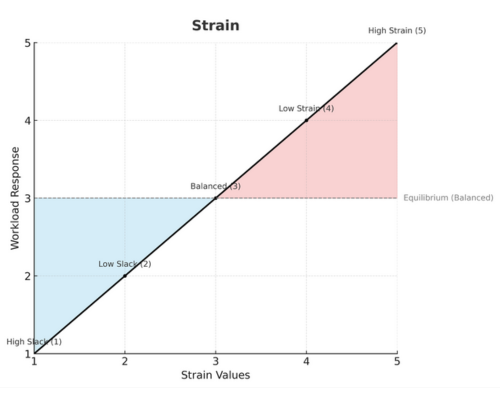
Expertise and intensity influence far more than job design, they determine organizational resilience. High-intensity work amplifies strain and attrition risk. High-expertise work magnifies dependency and succession risk. Measuring both allows leaders to plan with precision: balancing roles, distributing demand, and ensuring continuity in critical capabilities. Most importantly, Orgsure’s framework turns these abstract dimensions into quantifiable metrics. It replaces guesswork with evidence, allowing organizations to manage the human architecture of work as rigorously as their financial or structural architecture.
The Core Insight
Expertise and intensity are the invisible forces that shape how work feels, performs, and endures. Measured separately, they inform; measured together, they reveal the real dynamics of jobs and capabilities. By quantifying both at the activity level and aggregating them into position and structural profiles, Orgsure makes visible what others overlook. Leaders who understand the mix of expertise and intensity can design roles that are sustainable, allocate resources more effectively, and build organizations that balance knowledge, effort, and performance with precision.
Suscipit nibh nunc eu mauris platea
Un horaire flexible signifie bien plus qu’un simple aménagement : il incarne une nouvelle manière de concevoir le temps de travail. Ces dernières années ont vu l’adoption croissante de concepts novateurs tels que les horaires flexibles, aussi appelés flexitime.