

Workforce Planning Teams
Workforce planning teams ensure that the organization has the right people in the right roles at the right time. Their goal is to align workforce capacity and capability with strategic and operational demands while maintaining efficiency, stability, and fairness. Yet most workforce planning processes are constrained by incomplete or inconsistent data. Planners are often forced to work from headcount summaries, job titles, and averages that reveal little about what employees actually do, how much time work consumes, or how that work contributes to organizational value.
Traditional workforce models focus on staffing numbers rather than the nature and composition of work. Plans are typically based on job descriptions or historical ratios that bear limited resemblance to current operations. Without activity-level visibility, it is impossible to see how workload is distributed, which capabilities are over- or under-resourced, or how much of the organization’s capacity is devoted to strategic work versus maintenance or administrative effort. As a result, plans often perpetuate existing inefficiencies or overlook emerging skill gaps.
Another major challenge is the inability to connect labor costs to value creation. Financial systems can show what labor costs, but not whether those costs are being applied to the right work. Workforce planners also struggle to measure sustainability and continuity. High turnover or concentration of critical work in a few roles can threaten stability, yet these risks remain hidden when analysis is limited to headcount or budget.
The lack of consistent, comparable data across units makes enterprise-level workforce planning even more difficult. Functions may define roles differently or structure jobs around local priorities, preventing reliable comparison or aggregation. This fragmentation undermines the organization’s ability to plan for future needs, manage talent pipelines, or assess the workforce implications of strategic change.
How Orgsure Helps Solve These Challenges
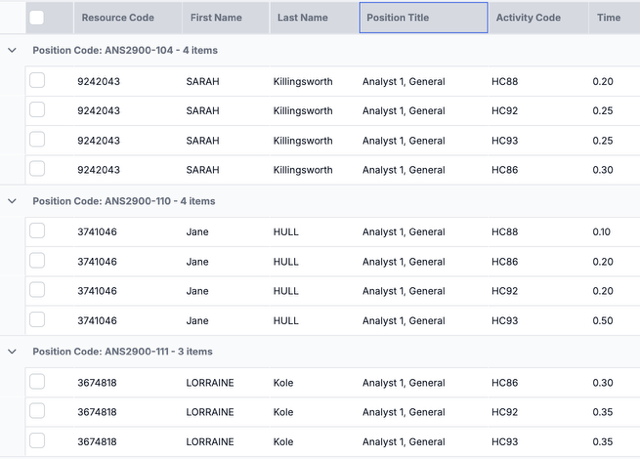
Orgsure transforms workforce planning from a headcount exercise into an evidence-based analysis of how work is performed and where value is created. The system begins by defining work through activities, the building blocks of work. Every position is mapped to its activities, each with detailed FTE allocation, cost, value, and capability alignment. This creates a measurable link between the work being performed and the resources assigned to perform it.
With this level of precision, workforce planners can see not only how many people occupy a role but what those people actually do and how their time is distributed across activities, capabilities, and value streams. Orgsure also includes position-level measures of value and strategic mix, enabling planners to assess how much of the organization’s effort supports strategic objectives versus routine or administrative work. This insight allows for targeted optimization, shifting capacity toward higher-value activities rather than across-the-board reductions or additions.
Because Orgsure integrates both cost and value data, planners can better allocate effort to investment. They can identify areas where labor spending delivers strong strategic or operational value, and where it does not. Activity-level granularity also supports capability-based planning, revealing where essential capabilities are under-resourced or unevenly distributed.
Workload and stability indicators, such as strain, intensity, exit risk, and continuity, help planners understand workforce sustainability. These measures show where capacity is at risk due to burnout, turnover, or dependency on critical individuals. When combined with capability and value data, this information enables planners to design workforce strategies that maintain resilience as well as efficiency.
Orgsure also allows planners to model the structural and cost implications of proposed changes before implementation. For example, adding or removing roles, reallocating work between functions, or automating specific activities can be tested in simulation, with predicted impacts on FTE, cost, and capability coverage. After changes are made, the same measures provide ongoing tracking, allowing planners to verify outcomes and adjust as conditions evolve.
With Orgsure, workforce planning becomes a continuous, data-driven discipline that connects people, work, and strategy. Planners can forecast with precision, align workforce investments with organizational value, and ensure that structures remain balanced and sustainable over time. The result is a workforce that is not only sized correctly but designed intelligently, ready to deliver both current performance and future growth.
Workforce Planning Teams
Workforce planning teams ensure that the organization has the right people in the right roles at the right time. Their goal is to align workforce capacity and capability with strategic and operational demands while maintaining efficiency, stability, and fairness. Yet most workforce planning processes are constrained by incomplete or inconsistent data. Planners are often forced to work from headcount summaries, job titles, and averages that reveal little about what employees actually do, how much time work consumes, or how that work contributes to organizational value.
Traditional workforce models focus on staffing numbers rather than the nature and composition of work. Plans are typically based on job descriptions or historical ratios that bear limited resemblance to current operations. Without activity-level visibility, it is impossible to see how workload is distributed, which capabilities are over- or under-resourced, or how much of the organization’s capacity is devoted to strategic work versus maintenance or administrative effort. As a result, plans often perpetuate existing inefficiencies or overlook emerging skill gaps.
Another major challenge is the inability to connect labor costs to value creation. Financial systems can show what labor costs, but not whether those costs are being applied to the right work. Workforce planners also struggle to measure sustainability and continuity. High turnover or concentration of critical work in a few roles can threaten stability, yet these risks remain hidden when analysis is limited to headcount or budget.
The lack of consistent, comparable data across units makes enterprise-level workforce planning even more difficult. Functions may define roles differently or structure jobs around local priorities, preventing reliable comparison or aggregation. This fragmentation undermines the organization’s ability to plan for future needs, manage talent pipelines, or assess the workforce implications of strategic change.
- Mini Heading
Common Problems
Incomplete or Inconsistent Workforce Data
Incomplete or inconsistent workforce data across units and functions.
Workforce Plans
Workforce plans based on job descriptions rather than real work activity.
Difficulty Linking
Difficulty linking headcount and FTE data to actual work performed.
Limited Ability
Limited ability to connect labor costs to value creation.
Lack of Position-level Visibility
Lack of position-level visibility into skills, capabilities, and work allocation.
Limited Insight
Limited insight into workload balance and capacity constraints.
Difficulty in Assessing
Difficulty assessing workforce stability and continuity risks.
Inability to Model
Inability to model the structural and cost impact of workforce changes.
No Consistent Framework
No consistent framework for comparing jobs across job levels, functions, or business units.
Challenges Integrating Workforce Data
Challenges integrating workforce data into broader strategic and operational planning.
How Orgsure Helps Solve These Challenges
Orgsure transforms workforce planning from a headcount exercise into an evidence-based analysis of how work is performed and where value is created. The system begins by defining work through activities, the building blocks of work. Every position is mapped to its activities, each with detailed FTE allocation, cost, value, and capability alignment. This creates a measurable link between the work being performed and the resources assigned to perform it.
With this level of precision, workforce planners can see not only how many people occupy a role but what those people actually do and how their time is distributed across activities, capabilities, and value streams. Orgsure also includes position-level measures of value and strategic mix, enabling planners to assess how much of the organization’s effort supports strategic objectives versus routine or administrative work. This insight allows for targeted optimization, shifting capacity toward higher-value activities rather than across-the-board reductions or additions.
Because Orgsure integrates both cost and value data, planners can better allocate effort to investment. They can identify areas where labor spending delivers strong strategic or operational value, and where it does not. Activity-level granularity also supports capability-based planning, revealing where essential capabilities are under-resourced or unevenly distributed.
Workload and stability indicators, such as strain, intensity, exit risk, and continuity, help planners understand workforce sustainability. These measures show where capacity is at risk due to burnout, turnover, or dependency on critical individuals. When combined with capability and value data, this information enables planners to design workforce strategies that maintain resilience as well as efficiency.
Orgsure also allows planners to model the structural and cost implications of proposed changes before implementation. For example, adding or removing roles, reallocating work between functions, or automating specific activities can be tested in simulation, with predicted impacts on FTE, cost, and capability coverage. After changes are made, the same measures provide ongoing tracking, allowing planners to verify outcomes and adjust as conditions evolve.
With Orgsure, workforce planning becomes a continuous, data-driven discipline that connects people, work, and strategy. Planners can forecast with precision, align workforce investments with organizational value, and ensure that structures remain balanced and sustainable over time. The result is a workforce that is not only sized correctly but designed intelligently, ready to deliver both current performance and future growth.